Energy Meter Parts

Your Professional Energy Meter Parts Manufacturer in China

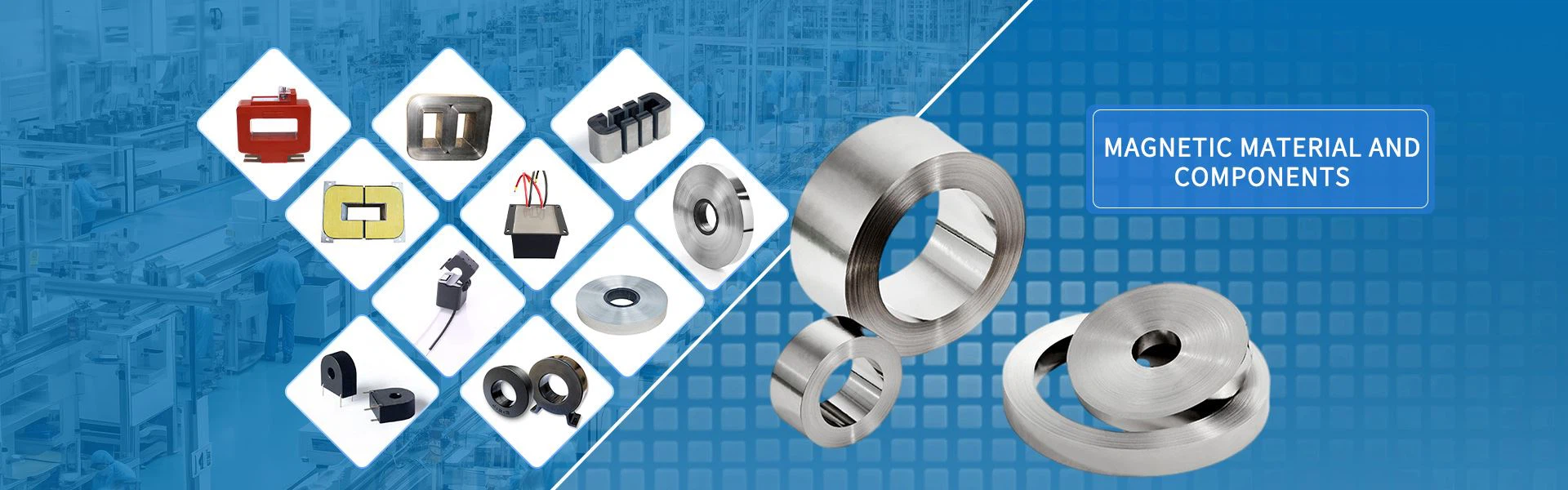
Sunbow Group specializes in the design, development and production of new-type amorphous, nanocrystalline, silicon steel sheets and other magnetic materials and related products. The company's main products include various types of amorphous, nanocrystalline ribbons and high and low voltage current transformer cores, precision current transformer cores, common mode inductor cores, PFC inductor cores, high frequency power transformer cores and related devices.

Customized Solutions

We are at the forefront of a design led approach to delivering challenging and custom solutions for magnetic cores or components for production. Whether your need is simple or complex, we can develop a solution to achieve your goals. With in- house experts we can design, develop and test prototypes that meet performance and environmental requirements of your application.

Advanced Equipment

The company has advanced equipment such as large-scale vacuum smelting furnaces, pressure spraying belts, various magnetic annealing furnaces and close cooperation with domestic scientific research institutions and universities, which ensures the company's R & D ability and product quality.


Complete Qualifications

At present, the company has two production bases, with a number of patented technologies, and has passed ISO9001, IATF16949 quality management system certification. All products have passed ROHS, SGS and other environmental protection certifications.


Wide Range of Applications

The company mainly serves the fields of new energy vehicles, photovoltaic power generation, wind power generation, smart home appliances, smart meters, wireless charging, and various power supplies, inverters, filter inductors, and shielding materials in the national strategic emerging industries.


First 12 Last 1/2

Introduction of Energy Meter Parts
 

The range of energy meter parts include energy meter metal terminals, brass screws, sealing screws, energy meter links, studs and more. The available range of energy meter parts are manufactured based on international quality standards. Our company manufacture the various types of energy meter parts for single phase, two phase or three phase energy meters. They are widely used in electrical, electronics, automobile, automation and other industries. The range of energy meter parts can be manufactured in any size, type, coating, material or other configuration based on custom specification and requirements.


Components of Energy Meter
 
01/

Meter Cover
Known for their durability and superior quality, our range of electronic meter covers provides complete safety to the meters kept inside. Our precision machining facilities as well as the expertise of trained staff enable us to successfully meet the diverse customized requirements of our clients.

02/

Current Shunt
Our company offers a vast range of current shunt, which is used for current controlling circuits and voltage sensing circuit. These shunts can be fixed directly to meter. Available in the capacity of 1 Ampere to 15000 Amperes, our range of metering shunts are also available as per the clients' requirements.

03/

Meter Base
Our range of energy meter base provides complete safety to the energy meters. Made from fine quality of raw material, our meter base is known for their fine finish and durable performances. We have the expertise and experience to offer other customized varieties according to the requirements of our clients.

04/

Circuit Board (PCB)
We manufacture and supply a wide range of circuit boards, which are applied in energy meters. These are fabricated using the best grade of materials, which is procured from the reliable manufacturers of the market. These circuit boards can serve as replacement of the parts of electricity meter, in case the original circuit board is broken.

05/

Step Register
Step Register is applied on electricity meters to display the data. LED or LCD display is also available as special request.

06/

Nameplate
We offer superior quality and uniquely designed name plates that are manufactured using high grade raw material, which is offered from reliable vendors.

07/

Terminal Cover
Our terminal cover offers a perfect blend of operator friendliness with powerful performance. Our terminal covers can also be customized in order to fit different safety standards of our clients.

08/

Current Transformer
As an electricity meter manufacturer, we also supply current transformer for uses in our electricity meters. These current transformers can produce reduced current when current in a circuit is too high. Our range of industrial current transformer and can be customized as per the needs of the clients.


List of Energy Meter Parts
Shunt for Energy Meter
Low-Voltage Current Transformer
Shunt for Energy Meter
Current Transformer for Electricity Meter

Energy Meter Shunt
Description
A shunt is a device that is designed to provide a low-resistance path for an electrical current in a circuit. It is typically used to divert current away from a system or component in order to prevent overcurrent. Electrical shunts are commonly used in a variety of applications including power distribution systems, electrical measurement systems, automotive and marine applications.

Advantages
First, they are simple current sensors that do not have any magnetic components. As a result, they are not susceptible to magnetic tampering, unlike current transformer (CT) sensors. This advantage is why shunts are commonly used as current sensors in markets where energy theft is a concern.
In addition, shunts are relatively inexpensive. Due to the cost-constrained nature of the e-meter market, this makes using shunts highly attractive for use as current sensors in single-phase meters.
One other advantage of shunts is that it can be used to measure current that is direct current (DC), unlike CTs or Rogowski coils. This advantage is particularly useful for specific applications. One such application that benefits from this advantage is for the sub-metering of server power supplies since some data servers may use DC power from an uninterruptible power source (UPS).
Shunts also exhibit lower phase shift of harmonics when exposed to signals at higher frequencies than CTs. This makes using shunts an attractive option for power quality monitors, which can analyze the harmonics of voltage and current to ensure the quality of the mains voltage provided to the consumer and the quality of the current waveform resulting from the consumer’s load.
Finally, unlike CTs, shunts do not have any inherent phase shift across temperature or input current, but keep in mind that this does not mean that phase compensation does not have to be performed. There are other sources of phase shift (such as anti-alias filters) that contribute to unintended phase shift between voltage and current so phase compensation would still be necessary to ensure high accuracy at lower power factors. With that being said, this does mean that based on the selected CTs there could be phase error variation when the input current or temperature is varied. As a result, the system phase error when using a current transformer can vary more than the system phase error when using a shunt. This higher phase error variation could make it more difficult to perform phase calibration simply and accurately, thereby potentially causing a variation in the measured power error across temperature or current.

Applications
Shunts mainly monitor the energy that flows out of a battery. However, they can serve many purposes when it comes to measuring an electrical current. Most battery monitors require a shunt on the negative side of the battery terminal. It then measures the real-time voltage of the system and the current draw. This allows the monitor to calculate the charge, remaining energy, and electricity consumption to display the information accurately.


Ct for Single-phase Electricity Meters


Energy Meter Terminal

Description
An energy meter typically has two terminals: one for the incoming supply and the other for the outgoing supply. These terminals are used to measure the amount of electricity consumed.

Advantages
Effectively converts a stranded conductor into a solid conductor, for a robust, reliable termination with a screw down style terminal.
Prevents the conductor from fraying leading to conductor loss and reduction in current carrying capacity.
Prevents conductor damage during handling, connection, or re-connection.
Much faster, more convenient, and safer than tinning the ends with solder.

Types
Line Terminal: This terminal is connected to the incoming supply line. It is usually marked as L or A.
Neutral Terminal: This terminal is connected to the incoming neutral line. It is usually marked as N or B.
Load Terminal: This terminal is connected to the load or the outgoing line. It is usually marked as L or A.
Neutral Terminal: This terminal is connected to the outgoing neutral line. It is usually marked as N or B.

Applications
Brass terminal blocks are used in several types of electrical applications. These include, among others.
Electronics, automobiles, plumbing, construction, and other industrial sectors.
Medical appliances, marine installations, building construction, heating, ventilation, and air conditioning.
Electrical switches and switchgear for transmission of electricity through brass terminal blocks.
Electric meters, earthmovers, and inverters for residential and commercial applications.


Customized Services for Energy Meter Terminal

We manufacture various types of energy meter terminals installed in different types of Single Phase & Three Phase Energy Meters like:
●Electronic Meter
●Electro Mechanical Meter
●Static Meters
Watt Hour Meter and many more types pf meters, used for Household and Industrial purposes.

Size
Shall be manufacture only as per customer's specified drawings and samples.

Threading
Various types and sizes of Threading like B.S.W., B.S.F., B.S.B., B.S.P. & B.S.P.T as per British Standard Whitworth Form and N.C. & U.N.C., N.F. & U.N.F., N.P.T & N.P.S., N.S., N.E.F. etc as per American National Form Threads are available. All threads shall be as per International GO & NO-Go Standards

Plating/Finish Available
Various types of Plating/Finish like Natural, Nickel, Silver, Tin or as specified are available as per specified layer of microns.

Material
High grade free cutting brass as per IS 319 (Type 1) or BS 249 (Type 1) or any other special Brass material composition as per customer requirement.

Ct for Three-phase Electricity Meters


Our Certificates


All products have passed ROHS, SGS and other environmental protection certifications.


productcate-749-300productcate-749-300


Our Testing Equipment


productcate-666-357productcate-665-357


Common Problem of Energy Meter Parts


Q: What is the purpose of a shunt in a meter?

A: A shunt (shunt resistor or an ammeter shunt) is a high precision resistor which can be used to measure the current flowing through a circuit. An ammeter shunt is a very low-resistance connection between two points in an electric circuit that forms an alternative path for a portion of the current.

Q: What does an electrical shunt do?

A: A shunt is an electrical device that generates a low-resistance path for an electrical current. This enables the current to flow to an alternative point in the circuit. Shunts may also be referred to as ammeter shunts or current shunt resistors.

Q: What is a current meter with a shunt?

A: The APM Shunt Meter is a shunt amp meter for measuring DC current in conjunction with an external shunt for applications including marine, leisure and material handling. Benefits include: Designed for use with an external shunts on low side applications.

Q: How does a shunt measure voltage?

A: Shunts are always employed when the measured current exceeds the range of the measuring device. The shunt is then connected in parallel to the measuring device. The entire current flows through the shunt and generates a voltage drop, which is then is measured.

Q: Is a shunt needed in solar system?

A: In Solar Panel installations, for the monitoring of DC current flowing out of the battery, it is important to install a measurement device such as a current shunt. The shunt measures the current draw of the battery system as well as the real-time voltage.

Q: What is the shunt resistance of a voltmeter?

A: The resistance value is given by the voltage drop at the maximum current rating. For example, a shunt resistor rated with 100 A and 50 mV has a resistance of 50 / 100 = 0.5 mΩ. The voltage drop at maximum current is typically rated 50, 75 or 100 mV.

Q: Where does the shunt need to be to measure amperage in a circuit?

A: To measure larger currents, you can place a precision resistor called a shunt in parallel with the meter. Most of the current flows through the shunt, and only a small fraction flows through the meter. This allows the meter to measure larger currents.

Q: What do shunts look like?

A: Most shunts have two catheters (small, thin tubes) connected by a valve. One end of the upstream catheter is in a ventricle. The other end of the downstream catheter is in the peritoneal (pair-et-NEE-ul) cavity. This is the space inside the belly where the stomach and the bowels are.

Q: How many amps does a shunt use?

A: A shunt is a resistor sized to the amperage of the rectifier. They may measure between one amp and 20,000 amps or more. It is typically made of brass, with thin pieces of resistive material connecting two larger pieces of brass.

Q: How do you wire an ammeter shunt?

A: Simply hook up the two terminals from the meter to each side of the shunt (one wire per side). Then place your shunt in series with the load or energy source you wish to monitor.
From the other side of the shunt, simply continue on to your charge controller (or disconnect, etc.).

Q: Is a shunt the same as a fuse?

A: When the current flowing through the fuse exceeds its rating, the fuse will melt or blow, breaking the circuit and preventing damage to the rest of the circuit or the connected devices. In summary, a shunt is used for measuring current, while a fuse is used for protecting a circuit from overcurrent.

Q: How is shunt connected in a circuit?

A: A shunt resistance 20 ohm is connected across a galvanometer in parallel, and the combination is connected to a cell of emf E through a resistance of 40 ohm. the ratio of potential difference across the shunt to that of the resistor is 1:3.

Q: Why are the Input Terminals on the Rear Panel of the Power Meter?

A: The input terminals on all Yokogawa power meteras are located on the rear panel. This takes into account safety when handling the measuring instrument. The signal input to the power meter normally carries high voltage and large current, so we place the terminals in the back so that the user will not accidentally touch an electrical component when operating the front panel keys. Recently, we are designing safety into our products through the use of safety terminals for voltage terminals, binding posts for current terminals, and protective covers that make it difficult to touch the terminals. However, sometimes you can forget the protective cover, or a disconnection happens unexpectedly, so to ensure safety we feel it is desirable to locate the input terminals on the rear panel.

Q: What is the back EMF of a transformer?

A: Alternating current varies, and accompanying magnetic flux varies, cutting both transformer coils and inducing voltage in each coil circuit. The voltage induced in the primary circuit opposes the applied voltage and is known as back voltage or back electro-motive-force (back EMF).

Q: What is the difference between electricity meter and energy meter?

A: This means that electricity meters only track the usage of electricity. Energy Meter: Energy meters, on the other hand, are more versatile. They measure various forms of energy, including electricity, gas, water, and thermal energy. These meters offer a holistic view of all energy types used within a facility.

Q: What is transformer E?

A: A transformer is a device that transfers electric energy from one alternating-current circuit to one or more other circuits, either increasing (stepping up) or reducing (stepping down) the voltage.

Q: What are the different types of electronic transformers?

A: The most common types of heating and cooling transformers are step up and step down transformers with step up transformers changing the voltage from high voltage AC 110 volts to low voltage AC 240 volts while step down transformers change the voltage from 240 volts to 110 volts and are used for industrial buildings.

Q: How does an electromagnetic transformer work?

A: Transformers contain a pair of windings, and they function by applying Faraday's law of induction. AC passes through the primary winding, which creates a varying magnetic flux. The magnetic field that results strikes the second winding and generates an AC voltage in that winding via electromagnetic induction.

Q: What are the terminals in energy meter?

A: These terminals are marked as L or A for Line, N or B for Neutral. A energy meter usually has four terminals. A pair of terminals for the current coil and another pair for the Voltage coil (a.k.a pressure coil).

Q: Are brass terminals better?

A: Brass battery terminals are often considered better than traditional lead terminals because they are more resistant to corrosion and can provide a better electrical connection. This can lead to improved battery performance and longevity.

Q: What is a current transformer used for?

A: A Current Transformer (CT) is used to measure the current of another circuit. CTs are used worldwide to monitor high-voltage lines across national power grids. A CT is designed to produce an alternating current in its secondary winding that is proportional to the current that it is measuring in its primary.

Q: What are CT and PT used for?

A: Hint: CT and PT type of transformer used in AC power. CT and PT both are measuring devices used to measure currents and voltages. They are used where large quantities of currents and voltages are used. The role of CT and PT is to reduce high current and high voltage to a parameter.

Q: What is the difference between CT and regular transformer?

A: In summary, the main difference is that a CT is specifically designed to measure current, while a transformer is used for transferring electrical energy between circuits. The main difference is current carrying capability.

Q: What are the advantages of a current transformer?

A: Current transformers reduce high voltage currents to a much lower value and provide a safe and convenient way of monitoring the actual electrical current flowing in an AC transmission. CT's work by converting the primary current into secondary current through a magnetic medium.

We're professional energy meter parts manufacturers and suppliers in China, specialized in providing high quality customized service. We warmly welcome you to buy energy meter parts made in China here from our factory.

Epoxy Coated Magnetic Core, Amorphous Material, energy meter terminal block

(0/10)

clearall