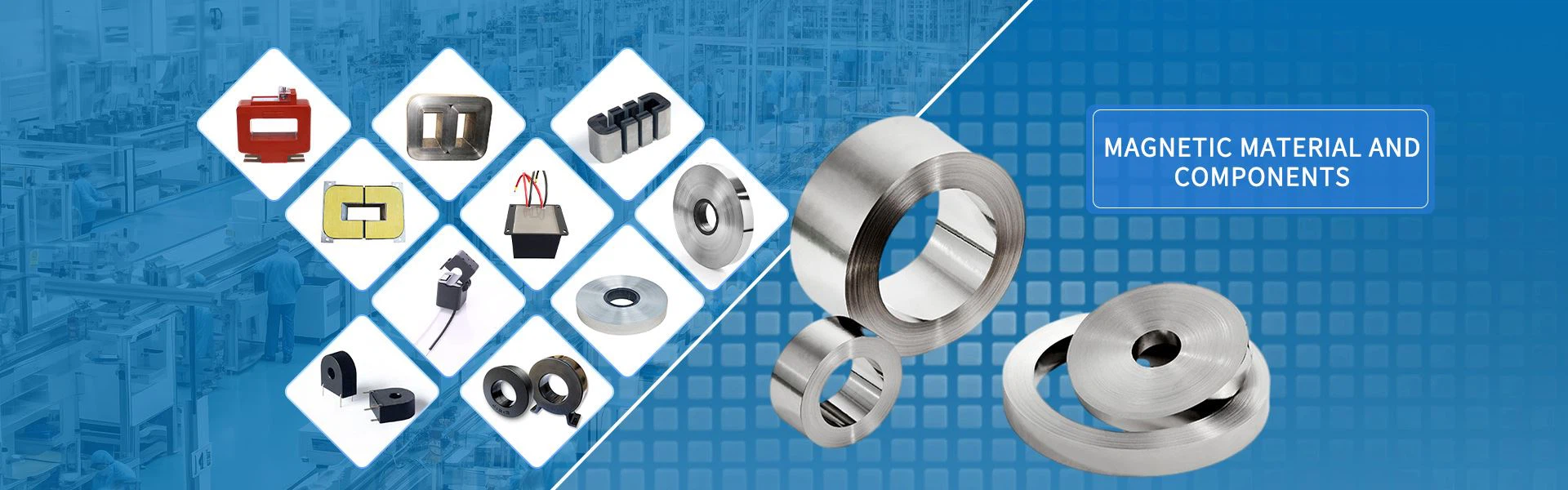
Q: What are the typical applications of Nanocrystalline Cores?
A: Common Mode Choke Cores (CMC Cores): Nanocrystalline common mode choke core has excellent frequency and impedance characteristics, which makes it the state-of-the-art material for a wide range of applications, e.g. power supply, electric drive and electric control systems for electric vehicles, photovoltaic power inverters, wind power converters, switching power supply for home appliances, as well as EMC solutions of industrial power supplies such as inverter welding machine.
High Frequency Power Transformer Cores (HFPT Cores): Nanocrystalline Power transformer cores are widely used in various high-frequency industrial power supplies. For example, nanocrystalline toroidal cores are mainly used in inverter welding machine power supply, induction heating equipment power supply, communication power supply, UPS power supply, X-ray machine power supply, laser power supply, variable-frequency power supply, etc. As for nanocrystalline rectangular and C-shape cores, they are mainly used in electric locomotive traction/auxiliary power supplies, DC converters, electrostatic precipitating power supplies, etc.
Current Transformer Cores (CT Cores): Nanocrystalline current transformer cores are mainly used in electric power transmission, electronic watt hour meters, and leakage protection switches, etc.
Q: What is the difference between ferrite core and nanocrystalline core?
A: When compared to ferrite cores, nanocrystalline cores provide a wider operational temperature range and significantly higher impedance at high frequencies.
Q: What is the difference between amorphous and nanocrystalline cores?
A: By the end of the production process, the amorphous cores remain with a metallic-glass structure, while the nanocrystalline cores obtain a refined structure of nanometric magnetic grains scattered in an amorphous metallic matrix.
Q: What is the temperature of a nanocrystalline core?
A: Nanocrystalline cores have very high curie temperature about 560℃, much higher than traditional ferrite core about 200℃. High curie temperature make nanocrystalline core excellent thermal stability, and can continuous working at up to 120℃ environment.
Q: What are the advantages of nanocrystalline?
A: What are the advantages of nanocrystals? Compared to ferrite cores, the impedance of nanocrystalline cores is extremely high and the effective frequency band is very wide. This allows components to be made smaller and saves engineering time that otherwise would be needed to design and test other EMI countermeasures.
Q: What are the disadvantages of nanocrystalline core?
A: Usually, the main disad- vantage of nanocrystalline cores for high power applications has been the significant increase in core losses after cutting.
Q: What are the uses of nanocrystalline core?
A: Nanocrystalline cores are mainly used in inverter welding machine power supply, X-ray/laser/communication power supply, UPS and high frequency induction heating power supply, charging power supply, electrolytic and electroplate power supply, as well as Frequency control of motor speed power supply.
Q: What is the material of nanocrystalline core?
A: Nano crystalline soft magnetic material is a new development. The material composition is 82% iron with the remaining balance silicon, boron, niobium, copper, carbon, molybdenum, and nickel. The raw material is manufactured and supplied in an amorphous state.
Q: What is a nanocrystalline material?
A: A nanocrystalline (NC) material is a polycrystalline material with a crystallite size of only a few nanometers. These materials fill the gap between amorphous materials without any long range order and conventional coarse-grained materials.
Q: Why are nanocrystalline materials stronger?
A: The increase in yield strength is a result of enhanced fraction of grain boundary, which impedes the motion of dislocations. Hence the strength of the nanocrystalline metals has been shown to increase by as much as an order of magnitude as the grain size decreases to lower limits of the nanoscale.
Q: What are the characteristics of nanocrystalline core?
A: Nanocrystalline ribbon is the standard core material for power components, mainly transformers for 1 - 80kHz and broad-band Common Mode Chokes (CMC). The core's key features include high saturation induction (1,2 – 1,7 T), low core losses, and the possibility to tailor core shapes and magnetic properties.
Q: What is a nanocrystalline structure?
A: Nanocrystalline materials are single- or multiphase polycrystals with crystallite sizes in the range of a few nm (typically 5–20 nm), so that about 30 vol% of the material consists of grain or interphase boundaries.
Q: Why we use nanocrystalline core for electronic components?
A: Lower loss, smaller and lighter: The loss of nanocrystalline cores is only 30% of permalloy cores, which is 70%-80% lower than ferrite cores. Therefore, transformers and inductors consume less power and are smaller in size, so nanocrystalline cores can be applied to more sophisticated instruments and equipment, which is not possible with ferrite cores.
Easy to process and manufacture: Nanocrystalline material can be made into different shapes, powder and spray ribbon are common, so nanocrystalline is an excellent material to alternative other materials (silicon steel or ferrite). Nanocrystalline ribbons can be used to make toroidal core or c cores, and the size of the magnetic core can be controlled more accurately by increasing or reducing the number of winding turns of the ribbon.
Nanocrystalline vs Ferrite: In today's trend of high-frequency components, nanocrystalline materials are more suitable than ferrite or silicon steel in applications such as transformers, current sensors, inverter, inductors, cores and coils. Its advantages are mainly reflected in the following aspects:
●High permeability in a wide frequency range.
●High saturation magnetic flux density.
●Low loss.
Q: What exactly are metallic nanocrystals?
A: The term "soft" in magnetics refers to a magnetic material that exhibits a low coercivity, such as an alloy formed by crystallizing a Fe-based amorphous magnetic materials alloy. Nanocrystal grains are equally distributed throughout this material's amorphous (or non-crystalized) state. At ambient temperature, this material is ferromagnetic, and when combined with nanocrystals, it achieves low saturation magnetostriction constant, making it an incredibly soft magnetic material. Because of its superior properties compared to traditional magnetic materials, this material was primarily employed in choke coils and transformers for power electronics. Because of its remarkable properties, its components may be considerably smaller.
Q: What are the uses of nanocrystalline core?
A: Nanocrystalline cores are mainly used in inverter welding machine power supply, X-ray/laser/communication power supply, UPS and high frequency induction heating power supply, charging power supply, electrolytic and electroplate power supply, as well as Frequency control of motor speed power supply.
Q: What are the applications of nanocrystalline materials?
A: Photovoltaic plants with energy storage systems. Solar-based hybrid energy systems with enriched overall efficiency. Hybrid energy systems and energy storage technologies. Phase change materials for thermal management.
Q: What is nanocrystalline technology?
A: Nanocrystals are carrier-free colloidal delivery systems that mean they are almost 100% drug. Drug delivered through nanocrystals have the potential of improving oral bioavailability of water insoluble drugs, reducing dose, increasing dissolution velocity and increasing particle stability.
Q: What is the structure of a nanocrystalline material?
A: Nanocrystalline materials are single- or multiphase polycrystals with crystallite sizes in the range of a few nm (typically 5–20 nm), so that about 30 vol% of the material consists of grain or interphase boundaries. Due to the huge amount of grain boundaries and/or the broad distribution of interatomic spacings in the grain boundaries the properties of nanocrystalline materials differ from that of crystalline and amorphous materials with the same chemical composition. Nanocrystalline materials seem to permit the alloying of conventionally insoluble components.
Q: Why are nanocrystalline materials stronger?
A: The increase in yield strength is a result of enhanced fraction of grain boundary, which impedes the motion of dislocations. Hence the strength of the nanocrystalline metals has been shown to increase by as much as an order of magnitude as the grain size decreases to lower limits of the nanoscale.
Q: What are the applications of nanocrystalline materials?
A: Photovoltaic plants with energy storage systems. Solar-based hybrid energy systems with enriched overall efficiency. Hybrid energy systems and energy storage technologies. Phase change materials for thermal management. Organic dyes, quantum dot as sensitizers. Solid-state dye-sensitized solar cells.
Q: What are the properties of a nanocrystalline core?
A: The crystalline atomic structure of a nanocrystalline core creates superior magnetic properties, including high saturation and very high permeability across a wide frequency range. Nanocrystalline alloys also exhibit low AC loss and high efficiency, even at high temperatures.