AI Power Supply Evolution Sparks a New Round of Magnetic Core Material Selection Revolution
Nov 03, 2026
AI Power Supply Evolution Sparks a New Round of Magnetic Core Material Selection Revolution
With rising power consumption per AI chip and server rack power density repeatedly exceeding original design limits, the traditional 48V low-voltage bus architecture struggles to reconcile high-current loss, cable temperature rise and space layout constraints. New solutions including 800V DC busbars, TLVR coupled inductors, high-frequency isolated power modules and magnetically integrated inductors have moved from concept to mass deployment, driving structural upgrades across the AI power supply ecosystem.
Magnetic cores, embedded inside power modules and rarely prioritized by front-end computing designers, stand at the heart of this material selection transformation. A consensus among hardware engineers is clear: while advances in semiconductor switches, capacitors and circuit topologies for AI power supplies are visible, the choice of magnetic core material often determines whether a power design can achieve stable mass production and meet target efficiency. For a long time, magnetic core selection for computing power supplies followed a straightforward rule: manganese-zinc ferrite for high-frequency applications, electrical steel for mains-frequency high-power isolation, and reuse of proven BOMs for cost-sensitive projects. This approach, however, is hitting inherent performance limits under today's high-density computing requirements.
I. AI Power Supply Redefines Operating Conditions for Magnetic Cores
AI power delivery is far more than simply combining "high power and high frequency". It comes with distinctive operating characteristics: Extreme dynamic load fluctuation. GPU and ASIC loads are non-steady. Switches between training and inference workloads trigger millisecond-scale current variations with large transient surges. Magnetic cores with inadequate DC bias capability readily enter saturation under heavy current impulses, causing sharp inductance collapse and deteriorating power output quality. High-temperature enclosed rack environment. Dense packaging in compute racks means components run continuously at 85°C or higher, under far harsher thermal conditions than conventional server rooms. The degree of magnetic performance degradation at elevated temperatures directly governs long-term system reliability. Shift toward mid-frequency operation and magnetic integration. To boost power density, next-generation power supplies operate at higher switching frequencies and widely adopt mid-frequency isolation, magnetic integration and coupled-inductor topologies, imposing tighter requirements on core loss, footprint and batch consistency.
The combination of these three operating stressors renders the old "one-fits-all" material selection strategy increasingly inadequate.
II. Limitations of Conventional Materials Exposed in Compute Scenarios
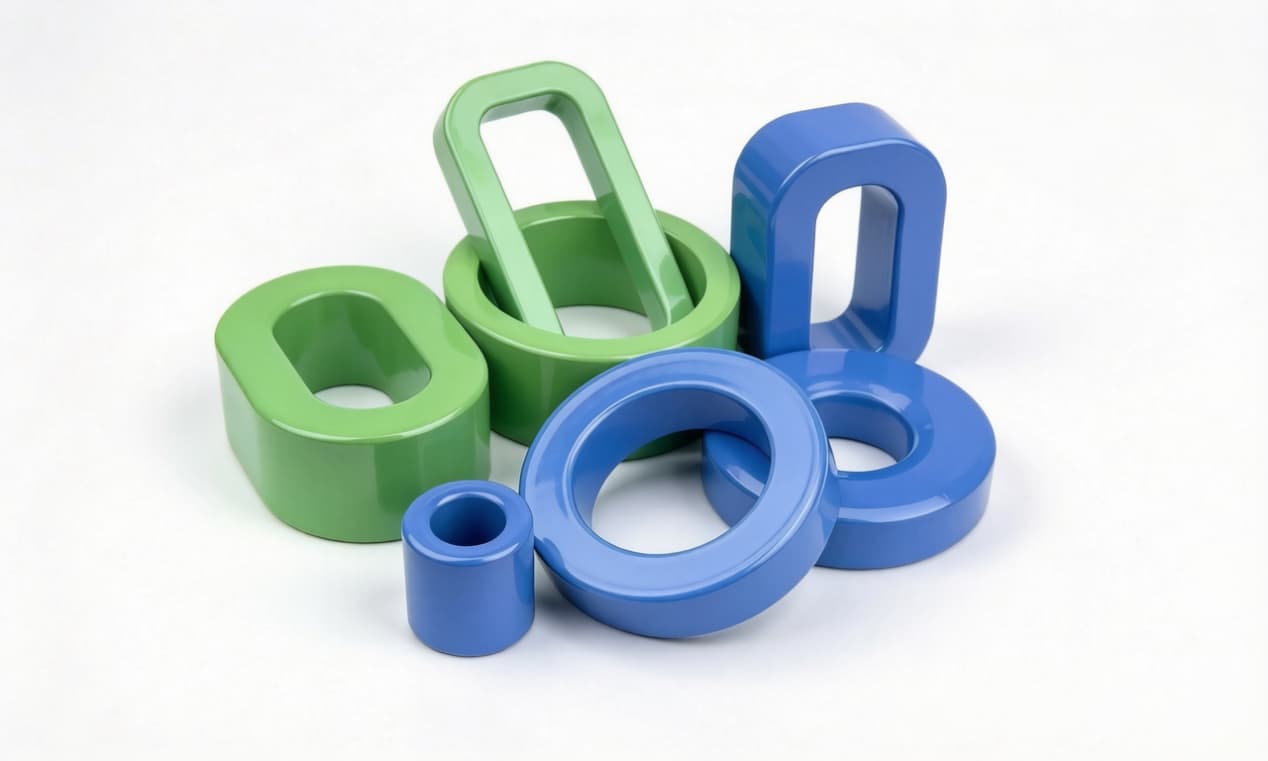
Manganese-zinc ferrite has long been the mainstream option for computing power supplies thanks to its favorable cost and low high-frequency eddy-current loss. Yet its drawbacks become pronounced in AI power applications: low saturation flux density (Bs), which drops significantly as temperature rises. Ferrite cores tend to saturate prematurely under large current surges. Once saturation occurs, inductance plummets and loss surges, creating a self-reinforcing vicious cycle of rising temperature and further saturation. For components such as TLVR coupled inductors that carry large dynamic DC components, standard ferrites cannot provide sufficient safety margin. Engineers are often forced to oversize magnetic cores to gain margin - conflicting with the miniaturization trend of compute power supplies.
Electrical steel works well for mains-frequency and low-frequency high-power designs. However, above several tens of kilohertz, its eddy-current loss rises rapidly, creating major thermal control challenges and making it poorly suited to the mid-frequency, compact design trend of modern AI power supplies.
These performance boundaries have led more design review teams to re-evaluate amorphous and nanocrystalline soft magnetic alloys for high-density compute power applications.
III. Amorphous and Nanocrystalline Alloys Enter Core Selection for Compute Power Supplies
Compared with traditional soft magnetic materials, amorphous and nanocrystalline alloys offer several highly valued properties for AI power scenarios:
- High saturation flux density: Nanocrystalline materials achieve saturation flux density above 1.2T, several times higher than standard MnZn ferrites. At equivalent power levels, they support higher operating flux density, enabling smaller inductors and transformers and improved power density - a critical advantage for space-constrained compute racks.
- Low mid-frequency core loss: Amorphous and nanocrystalline alloys feature low hysteresis loss across the mid-frequency band, reducing self-heating of the magnetic core. This helps curb system temperature rise, improve conversion efficiency and simplify thermal designs.
- Stable performance over a wide temperature range: Nanocrystalline alloys have a high Curie temperature and exhibit mild magnetic property degradation above 85°C. They minimize parameter drift induced by temperature swings and sustain stable performance during prolonged heavy-load operation.
- Robust DC bias resistance: Against frequent load transients in AI systems, their B-H curves feature a wide linear region. With properly designed air gaps and windings, saturation risks under DC bias are effectively mitigated, ensuring stable system operation amid abrupt load changes.
- In practical applications, amorphous and nanocrystalline cores are proving valuable as alternatives or supplements to conventional materials for PFC inductors, common-mode chokes and filter inductors in server power supplies, as well as emerging TLVR coupled inductors and high-frequency isolated power modules. They allow engineers to achieve better trade-offs among footprint, temperature rise and EMI performance under identical electrical specifications.
IV. Selection Logic Shifts from Experience-Based to Condition-Driven
It should be emphasized that this transformation does not mean full replacement; no single magnetic material is universal. Ferrites remain irreplaceable for high-frequency resonant links operating above 100 kHz. Mature magnetic powder core solutions still deliver optimal cost performance for cost-sensitive auxiliary power supplies with stable loads.
The industry shift is this: magnetic core selection is moving away from empirical material matching toward boundary-condition-driven design. Instead of assigning fixed materials to fixed topologies, engineers first define design inputs including bus voltage, switching frequency, DC bias magnitude, maximum operating temperature, surge load frequency and EMI targets, then select the matching soft magnetic material system accordingly.
This trend brings new requirements to magnetic core suppliers. AI projects iterate rapidly with frequent design revisions. Power engineers need quick access to measured data for cores of different specifications covering loss, permeability, bias characteristics and thermal drift - rather than relying solely on nominal datasheet values. Simulation is only for reference; measurement validation under realistic compute operating conditions is essential for successful design implementation.
V. The Hidden Decisive Factor for Compute Power Delivery
SUNBOW keeps pace with advances in compute power supply architectures and specializes in amorphous and nanocrystalline magnetic core solutions. We work closely with power engineers to develop designs for server common-mode inductors, TLVR coupled inductors, high-voltage filter inductors and mid-frequency isolated power modules. We continuously refine our products around loss optimization, bias suppression and consistency control, aligning with evolving power delivery architectures to resolve electromagnetic challenges for high-density compute systems.
The AI sector continues to accelerate, power supply innovation will not stop, and criteria for magnetic core selection will keep evolving. While the industry focuses on chips, power semiconductors and system energy efficiency, understanding the performance boundaries of soft magnetic materials and fully leveraging magnetic core capabilities will become the hidden differentiator for competitive power supply designs.
SUNBOW, YOUR BEST PARTNER OF MAGNETIC MATERIALS