Amorphous & Nanocrystalline Alloys:Stealthily Penetrating Compact Devices - Wireless Charging, Humanoid Robots and EV Charging Piles
Oct 27, 2026
When amorphous and nanocrystalline magnetic cores are mentioned, many engineers first associate them with large magnetic components in high-power inverters and server power supplies. Few have noticed that this new family of soft magnetic materials is quietly finding its way into a new generation of lightweight, miniaturized precision devices. Hidden inside wireless charging modules, miniature joints of humanoid robots, and filter inductors for new-energy charging piles, these compact components govern thermal rise, EMI performance and operational stability, serving as an invisible cornerstone for the iteration of next-generation hardware.

As consumer electronics, robotics and EV charging systems shift toward higher frequency and smaller form factors, traditional ferrite materials are increasingly hitting performance ceilings. Their low saturation magnetic flux density, high high-frequency loss and marked permeability degradation at elevated temperatures become pronounced pain points under high power, confined enclosures and dynamic load conditions. By contrast, amorphous and nanocrystalline alloys feature high saturation flux density, stable performance across wide temperature ranges and low loss at high frequencies. These merits have enabled the materials to expand from conventional high-power industrial equipment into a variety of small precision devices, resolving long-standing material bottlenecks.
Wireless Charging: Ultra-Thin Magnetic Shielding to Mitigate Heat and Boost Coupling Efficiency
The core challenge of wireless charging lies in magnetic field confinement. Without suitable magnetic shielding, magnetic flux lines emitted by the coil penetrate battery packs and metallic housings, inducing eddy currents in metal structures. This triggers two critical issues: sharp temperature rise during charging, offset magnetic fields that reduce coupling efficiency, and even interference with NFC signals.
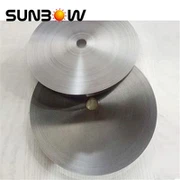
Ferrite magnetic sheets have been widely adopted in past designs, yet they are brittle, difficult to fabricate ultrathin, and suffer from excessive loss in high-power wireless charging applications. Magnetic shielding sheets made from ultra-thin nanocrystalline ribbons create a low-reluctance path for magnetic flux, confining the magnetic field between transmitting and receiving coils, suppressing eddy-current heating in metal parts and improving energy coupling efficiency.
Nanocrystalline shielding sheets, thin and flexible, are suitable for consumer-grade wireless charging in smartphones and wearables as well as high-power automotive wireless charging for autonomous vehicles. At equivalent power levels, they achieve a much thinner profile than ferrite alternatives with lower high-frequency loss and superior thermal control during sustained charging, balancing charging efficiency and device safety. For 20 kW automotive wireless charging solutions, nanocrystalline magnetic cores help deliver high system conversion efficiency while reducing magnetic core thickness and boosting overall power density, aligning with the trend of unmanned autonomous energy replenishment.
Humanoid Robots: EMC and Motion Precision Guardians Inside Miniature Joints
The technical challenge for humanoid robots is not the peak power of a single motor, but dozens of miniature servo joints distributed across the body. These joints have extremely limited internal space, and high-frequency switching of servo drives continuously generates electromagnetic noise. Uncontrolled EMI can couple into attitude sensors, causing signal drift, jerky motion, jitter and even safety hazards.
Tight packaging, frequent dynamic load fluctuations and alternating high and low temperatures impose three stringent requirements on magnetic components for robot joints. Traditional ferrite cores have low saturation flux density and readily saturate under peak servo current, rendering filtering ineffective. Nanocrystalline cores deliver far higher saturation magnetic flux density and stronger DC bias resistance. They maintain unsaturated magnetic circuits amid frequent start-stop cycles and sudden load changes in joints, continuously suppressing common-mode interference.
Thanks to high permeability, nanocrystalline cores require fewer winding turns for a given inductance value and allow substantial miniaturization to fit within cramped joint cavities. Heat dissipation inside sealed joints is limited, while nanocrystalline alloys maintain stable magnetic properties across wide temperature swings, minimizing control errors induced by temperature variation.
The per-robot consumption of such magnetic cores is modest, yet specifications for consistency and permeability tolerance are highly demanding, making this a high-value precision soft-magnetic application. Amorphous and nanocrystalline materials underpin smoother and more stable motion control in humanoid robots, deployed in common-mode chokes on joint power buses and miniature magnetic cores for current sensing.
New-Energy Charging Piles: Filtering and High-Frequency Conversion Solutions for Fast Charging
High-power ultra-fast charging piles are gaining widespread adoption, ranging from 7 kW AC chargers to megawatt-level ultra-fast charging systems. Power modules in charging piles keep moving toward higher operating frequencies. Internal high-frequency transformers and common-mode filter inductors operate continuously under large currents and wide temperature ranges.
Traditional ferrites tend to saturate easily under high-frequency large-current conditions, with rising loss and heavy thermal stress. Bulk heat dissipation structures are therefore required, increasing the size and cost of complete units. Amorphous and nanocrystalline magnetic cores are primarily used for common-mode inductors and high-frequency conversion components in charging modules. Their high saturation flux density resists saturation against instantaneous peak charging current; low high-frequency loss cuts core heating, eases thermal design constraints and shrinks module footprint. Excellent EMI suppression also helps products pass EMC compliance tests more readily and reduce rectification costs during debugging.
Many hardware developers make a common mistake in component selection: focusing solely on the unit procurement cost of magnetic cores while overlooking total system costs associated with heat dissipation, enclosure size and long-term failure rates. Charging modules equipped with nanocrystalline cores feature lower magnetic loss, consistent performance across the full load range and enhanced reliability for continuous operation. They are well suited for outdoor charging piles exposed to wide diurnal temperature variations and non-stop duty cycles.

Underlying Material Logic: Not a Simple Replacement, but Upgrade Driven by Application Requirements
Behind these three seemingly unrelated devices lies one shared requirement: to withstand higher frequencies and greater current fluctuations within shrinking space, while stabilizing temperature rise and EMI performance. Ferrite remains cost-effective and adequate for low-frequency, low-power scenarios. Its drawbacks become prominent only in high-frequency applications with dynamic heavy current and enclosed high-temperature environments.
Amorphous and nanocrystalline alloys are not designed to replace ferrites universally. Instead, they offer an alternative material route for these demanding niche scenarios. Amorphous alloys are produced by rapid quenching, where metallic atoms are frozen before forming regular crystalline lattices. Nanocrystalline materials are derived from amorphous precursors via heat treatment to precipitate nanoscale grains. This microstructure endows them with high permeability, low coercivity, low high-frequency loss, high saturation flux density and stable magnetic response over broad temperature ranges.
Nevertheless, these materials impose strict requirements on thermal processing, ribbon thickness and tension control during forming. Process governance directly determines batch consistency. SUNBOW has specialized in amorphous and nanocrystalline magnetic cores for more than a decade. Leveraging high-precision temperature-controlled thermal treatment, the company ensures uniform magnetic circuits and stable batch performance to resolve EMC consistency challenges in mass production. Permeability can be precisely tuned over a wide range, enabling customized magnetic core solutions for wireless charging shielding sheets, miniature filter rings for humanoid robot joints and common-mode inductors for charging piles, with products validated by numerous end-user projects.
Closing Remarks
Often, the performance ceiling of hardware products is ultimately bounded by foundational materials. Thermal issues in wireless charging, electromagnetic crosstalk in humanoid robot joints, and thermal rise plus EMC rectification challenges in high-power charging piles may appear to stem from circuit and mechanical design. Their root cause frequently lies in magnetic core materials.
No longer exclusive to heavy-duty high-power industrial equipment, amorphous and nanocrystalline soft magnets are steadily permeating compact precision devices. In invisible ways, they support the miniaturization, efficiency improvement and reliability upgrade of next-generation equipment. As new hardware platforms pursue ever-higher power density, the value of advanced soft magnetic materials will gain wider recognition among hardware engineers.
SUNBOW
YOUR BEST PARTNER OF MAGNETIC MATERIALS