In-depth Analysis of Magnetic Field Heat Treatment Process for Common-mode Cores: How to Select for Low Frequency, Medium and High Frequency Applications
May 29, 2026
I. First, Understand: Why Magnetic Field Heat Treatment Is Mandatory for Common-mode Cores
With the widespread adoption of new energy photovoltaic systems, energy storage inverters, vehicle-to-grid (V2G) systems and various frequency conversion equipment, harmonics, high-frequency interference and DC bias have become commonplace in power grids.
As a core component for EMI filtering and common-mode noise suppression, the overall performance of a common-mode inductor - including impedance, power loss and batch consistency - is largely determined by the magnetic core heat treatment process.
Many manufacturers focus merely on ribbon material, winding turns and bobbin structure, while neglecting the heat treatment principles, temperature matching and magnetic field process selection. This will easily lead to the following issues:
Large parameter deviation within the same production batch
Obvious parameter drift under high and low temperature operating conditions
Sharp drop of inductance and impedance curves at high frequencies
Poor DC bias resistance, resulting in difficulties in passing EMC certification
II. Standard Process Principles: Two Mainstream Solutions - Vacuum Annealing & Transverse Magnetic Field Heat Treatment

High-permeability Coated Magnetic Core Vacuum Heat Treatment

Transverse Magnetic Field Heat Treatment
wo mature process routes are widely adopted in the industry:
1. Two-step Process
First, perform independent vacuum annealing to complete grain crystallization and stress relief of magnetic cores.
Then transfer the cores to dedicated equipment for transverse magnetic field heat treatment.
Temperature, magnetic field and atmosphere parameters are controlled separately. This process features high adjustability, ideal for small-batch and highly customized products.
2. Integrated Continuous Heat Treatment with Vacuum & Transverse Magnetic Field (Mainstream for Mass Production)
This is the most widely used proven solution for high-volume manufacturing. Within one transverse magnetic furnace, the vacuum annealing stage is completed first, followed directly by transverse magnetization under inert atmosphere protection.
The whole process runs continuously without secondary handling, minimizing human error and environmental interference. It delivers excellent batch consistency and high production efficiency, perfectly suited for large-scale production of common-mode magnetic cores.
Core Process Objectives
Vacuum Stage
Eliminate mechanical internal stress generated during slitting and winding, and complete grain recrystallization. The cores are annealed to achieve the baseline state of high initial permeability, purify the microstructure and reduce hysteresis loss.
Transverse Magnetic Field Stage
With directional transverse magnetic field and precise temperature control, regular domain alignment is induced to optimize the hysteresis loop. It stabilizes linear permeability, improves permeability across low and high frequencies, and enhances DC bias resistance.
Summary
Vacuum annealing lays a solid foundation for material microstructure, while transverse magnetic field heat treatment determines magnetic properties, linearity and overall electrical performance across the full frequency range.
III. Low Frequency vs. Medium & High Frequency: Distinct Magnetic Field Heat Treatment Processes

Integrated Vacuum & Transverse Magnetic Heat Treatment for High Initial Permeability Insulation-Coated Magnetic Cores
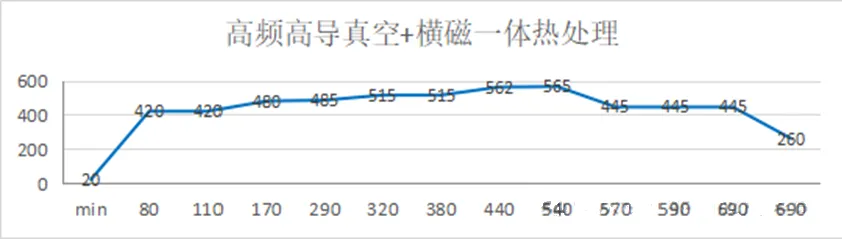
ntegrated Vacuum & Transverse Magnetic Annealing for High-Frequency High-Permeability Cores
1. Common-mode Cores for Low-frequency Operation
Application: Power frequency filtering, general household appliances and conventional low-frequency EMI suppression.
Process selection: Low-temperature transverse magnetic annealing
Adopt moderate magnetic field strength with mild holding temperature range.
Focus on stable permeability and low loss at power frequency.
Ensure basic DC bias resistance to meet general EMI filtering requirements.
2. Common-mode Cores for Medium & High-frequency Operation
Application: PV inverters, on-board power supplies, servers and high-frequency switching power supplies.
Test Standard Description
Inductance values at 10 kHz and 100 kHz are standard test items for medium & high-frequency products.
For high-end products, full-frequency impedance curve testing is additionally required.
For ultra-high-frequency applications at MHz level, impedance is taken as the core evaluation criterion in the industry.
Process selection: High-temperature & high-strength transverse magnetic annealing
Both heat treatment temperature and transverse magnetic field strength are set higher than those for low-frequency processes.
Specifically boost permeability at 10 kHz and 100 kHz bands.
Suppress high-frequency loss and prevent inductance & impedance degradation across the full frequency range.
The process window is extremely narrow. Vacuum degree, temperature, magnetic field and heating/cooling rates must be precisely coordinated.
IV. High-end High-frequency Common-mode Cores: Special Heat Treatment Requirements for Ultra-thin Ribbons

High-end medium & high-frequency common-mode inductors generally adopt ultra-thin nanocrystalline ribbons of 12~14 μm. Their process
parameters cannot be shared with ribbons of conventional thickness:
Ultra-thin ribbons feature fine grains and are extremely sensitive to temperature fluctuation and magnetic field uniformity.
The transverse magnetic annealing requires a higher magnetic field strength combined with stepped multi-stage temperature control.
Gradual and slow cooling is mandatory after heat preservation. Rapid cooling will cause magnetic domain rebound and deteriorate high-frequency linearity and impedance characteristics.
Higher requirements are imposed on furnace vacuum degree and atmosphere protection to prevent high-temperature oxidation and damage to interlayer insulation, which would otherwise lead to a sharp rise in high-frequency loss.
V. Mandatory Guidelines for Mass Production of Magnetic Field Heat Treatment for Common-mode Cores
Strictly control furnace vacuum and atmosphere conditions
Insufficient vacuum will cause oxidation on the ribbon surface and insulation coating, resulting in increased loss, degraded high-frequency performance and poor batch consistency.
Ensure uniform distribution of transverse magnetic field for toroidal cores
Uneven magnetic field leads to disordered magnetic domain alignment, and large dispersion of inductance, loss and impedance within the same batch.
Forbid rapid discharge right after heat preservation
Gradual slow cooling is required. Excessively fast cooling will disrupt the aligned magnetic domains and weaken the linearity and DC bias resistance achieved by transverse magnetic treatment.
Separate furnaces and processes for different materials
Nanocrystalline materials vary greatly in crystallization temperature and transverse magnetic parameters. Mixed firing in one furnace is not recommended to avoid mutual interference of performance.
Avoid secondary high-temperature impact after heat treatment
Strictly control the temperature in subsequent potting, welding and reflow soldering. Secondary high temperature will break the stable state of magnetic domains, causing parameter drift and failure of EMI filtering.