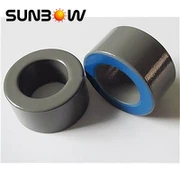
Why Nanocrystalline Cores Are the Optimal Choice for Common Mode Inductors (EMC)
Apr 27, 2026
Common mode inductors require high permeability, anti-saturation performance, low loss, wide-frequency stability and excellent temperature resistance. Nanocrystalline cores outperform ferrite, silicon steel, Fe-Si-Al and other materials in all these aspects, making them the premium solution for EMC common mode inductors.
I. Core Advantages (Core Requirements for Common Mode Inductors)
01 High Saturation Magnetic Flux Density
The saturation flux density (Bs) of nanocrystalline materials ranges from 1.2 to 1.25 T, 2–3 times that of ferrite (0.3–0.5 T). It is resistant to saturation under high current and strong interference, preventing a sharp drop in inductance and failure of EMI suppression. Its temperature rise is 10–20 ℃ lower than ferrite cores.
02 Ultra-High Initial Permeability
Nanocrystalline cores feature an initial permeability (μi) of 10⁴–10⁵, 5–20 times higher than ferrite (10³–10⁴). With the same size and turns, they deliver higher impedance and insertion loss for better suppression of weak interference. They also enable significant size reduction and fewer winding turns.
03 Stable Permeability Over Wide Frequency Range
Nanocrystalline materials maintain over 80% permeability below 1 MHz, while ferrite only retains around 50%. It covers the interference frequency band of 100 kHz to 100 MHz, ensuring consistent EMI suppression across all frequencies.
04 Ultra-Low High-Frequency Loss (Hysteresis & Eddy Current Loss)
With an ultra-thin ribbon thickness of 10–30 μm and ultra-fine grain size of 10–20 nm, nanocrystalline cores generate less heat at high frequencies and achieve higher efficiency.
05 Outstanding Temperature Stability
The Curie temperature of nanocrystalline materials is approximately 570 ℃, compared to only 120 ℃ for ferrite. Its magnetic properties remain nearly unchanged from -40 ℃ to 150 ℃, perfectly adapting to harsh high-temperature environments such as automotive and industrial applications.
06 Strong Resistance to Unbalanced Current
Common mode inductors are often affected by differential current bias. Nanocrystalline cores have far better bias resistance than ferrite, ensuring long-term stable operation.
II. Comparison with Mainstream Soft Magnetic Materials
1.Nanocrystalline vs MnZn Ferrite
✅ Higher permeability, higher Bs, lower loss, superior temperature stability and smaller size
⚠️ Higher cost
2.Nanocrystalline vs Silicon Steel
✅ 10+ times higher permeability, extremely low high-frequency loss, much smaller volume
❌ Silicon steel is only applicable to power frequency scenarios
3.Nanocrystalline vs Fe-Si-Al
✅ Higher permeability, higher saturation flux density, lower loss and better wide-frequency performance
⚠️ Higher cost
III. Fundamental Reason for Being the Optimal Choice
The core function of common mode inductors is to provide continuous high impedance and effective EMI suppression under wide frequency, high current and high-temperature conditions.
Nanocrystalline technology integrates high permeability, anti-saturation, low power loss, wide-frequency adaptability and high temperature resistance. It is currently the only soft magnetic material that comprehensively outperforms traditional alternatives in high-end, high-power and high-temperature application scenarios.
IV. Typical Application Scenarios
- Switching power supplies, UPS, photovoltaic and wind power inverters
- New energy vehicle OBC, motor controllers
- Industrial inverters, servo drives and medical equipment
- Devices requiring high power density and high EMC performance
Do you currently use nanocrystalline cores in your products?